5 min read | Home Technology | Low Voltage Installation
You moved into a home that looks great. The Wi-Fi, however, tells a different story. The back bedroom drops connection. The basement never gets a solid signal. The living room works fine but the home office is another matter entirely.
You know wireless access points are the answer. The problem is that the drywall is already up and running cable feels like a bigger deal than it probably should be.
Here is the truth: in most homes it is far more manageable than homeowners expect. Homes are built with natural pathways that make running cable cleaner and less invasive than tearing walls apart. Knowing how to use those pathways is the difference between a professional installation and one that looks like an afterthought.
The Walls Are Already Up. Now What?
The first question we ask when we walk into a home is not “where do the walls go.” It is “what access do we have.” Every home is different, but most share common architectural features that give us a clean route for cable without turning your living space into a construction zone.
There are three primary methods we use to get cable where it needs to go.
How We Route Cable in a Finished Home
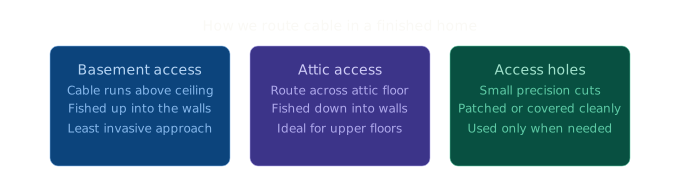
Basement access is the most common starting point for single-level homes and ranch-style layouts. Our technicians access the space below the main floor, run cable above the basement ceiling, and fish it straight up through the wall cavity to exactly where it needs to go. The finished space above stays untouched.
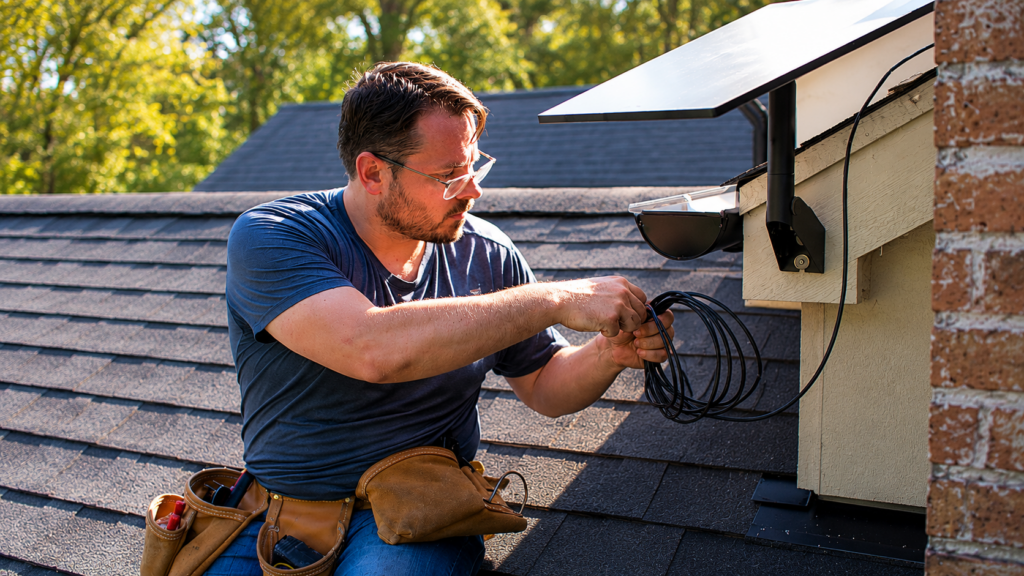
Attic access gives us a clean top-down route for upper floors and multi-level homes. Cable runs across the attic floor and fishes down through the interior walls. In some cases runs travel along the exterior of the home to reach locations that cannot be accessed from inside. Both are standard approaches and both leave your home looking like nothing happened.
Access holes come into play when a specific run does not have a clear path from above or below. When we make an access hole, we do it with precision. The cut is as small as possible and is either patched or covered with a clean wall plate. When we leave, it looks intentional.
What We Are Actually Running
Not every cable run is the same. Depending on what you are building out, we may be running one type of wire or several. Here is how each one fits into the finished system.
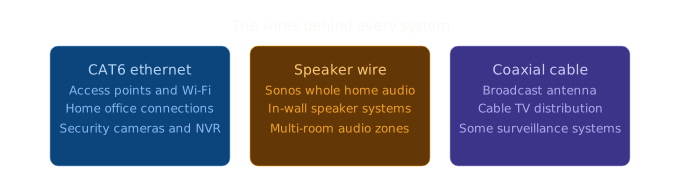
CAT6 ethernet is the most common cable in a networking installation. It feeds every wireless access point in your home, delivers a rock-solid wired connection to home offices and media rooms, and supports IP security cameras and network video recorders. Every access point in a whole home Wi-Fi system needs a dedicated CAT6 run back to your network switch to perform at full strength. There is no substitute for that wired backbone.
Speaker wire is what makes whole home audio work the right way. For homes running a Sonos system, in-wall speaker wire runs from each speaker location back to a central amplifier. Sonos is one of the most reliable and intuitive whole home audio platforms available. Getting clean, in-wall speaker wire runs is what makes the installation look and sound the way it should. Exposed wire running along baseboards is not part of how we work.
Coaxial cable handles broadcast antenna connections, cable TV distribution to multiple rooms, and certain surveillance applications. If you are adding an over-the-air antenna for local channels or routing an existing cable signal throughout the home, coaxial is the cable that makes that work cleanly.
Planning the Run Before We Touch a Wall
Every cable run starts with a conversation and a walkthrough. Before we drill a single hole we know where every wire is going, what path it is taking, and what it will connect to when it gets there.
This matters more than most people realize. A thoughtful plan is what keeps the number of cuts to a minimum, ensures every run serves a real purpose, and means the finished system looks and performs exactly the way it should. We are not guessing once we are in the wall. We already know.
This is especially true when multiple systems are being run at once. A home adding access points, a Sonos audio system, and surveillance cameras in the same project requires coordination between every run. CAT6 for the network. Speaker wire for audio. Coaxial where it is needed. All planned together so nothing gets missed and nothing needs to be redone.
Surveillance and Whole Home Audio Done Right
Security cameras are one of the most requested additions we see in homes across the Chicagoland area. A properly wired surveillance system means cameras that record continuously, connect reliably, and do not depend on a wireless signal that can drop at the wrong moment. Every camera we install gets a dedicated wired connection back to the NVR.
For whole home audio, Sonos is the system we trust. When it is installed correctly with clean in-wall speaker wire runs and a properly configured network, it performs exactly the way it was designed to. You control everything from your phone. The music follows you through the house. Nothing drops, nothing glitches, nothing fights for bandwidth.
Serving Homeowners Across Chicagoland
We run wire in homes of every size and construction type across Naperville, Aurora, Bolingbrook, and the broader western suburbs every week. Whether your home is a newer build that missed the prewire window or an older property that needs infrastructure added after the fact, we have done it in homes like yours.
Chicagoland homes come in all shapes and construction types. Brick, older construction, multi-level layouts with finished basements we work through all of it. The approach changes by home. The standard of the finished install does not.
Ready to Stop Living With Dead Zones?
The answer starts with a walkthrough. We will look at your home, map out where the wire needs to go, and give you a clear plan for building a system that actually works without making a mess of your walls.