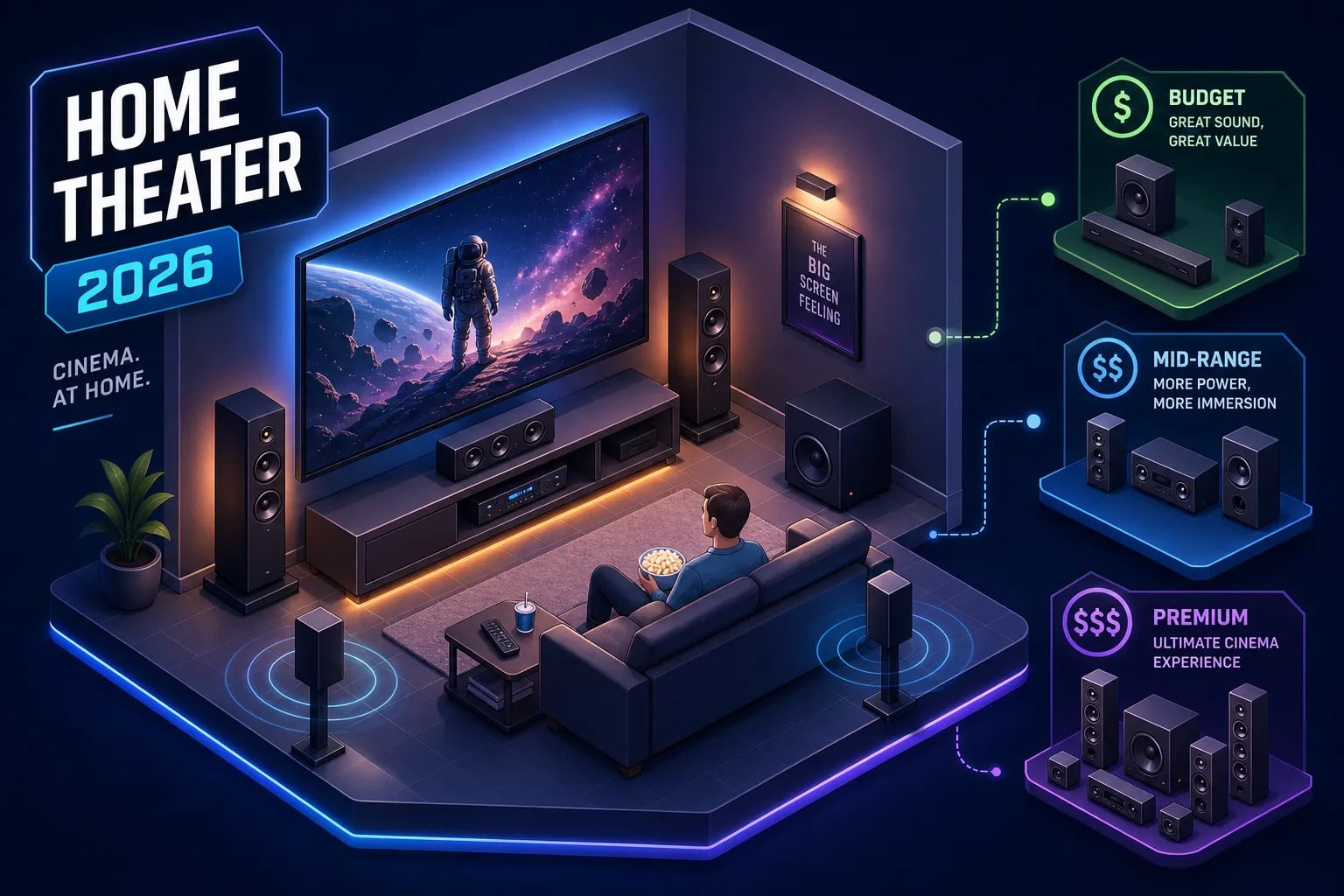
A home theater system is five things working together: a display, a properly calibrated audio system, acoustics that don’t sabotage your speakers, seating aligned with the screen, and a control layer that runs the whole show. Your TV is the starting point, not the finish line. Most homeowners have nailed the first part and stopped there, then wondered why movies still feel flat.
Our team walks into homes across Naperville and the western suburbs regularly and finds the same scene: beautiful TVs bolted to walls, hardware stacked on shelves, and nothing talking to anything else. Four remotes. One frustrated homeowner. This guide explains what a proper home theater setup actually includes, how to choose between soundbars and component systems, which configuration fits your room, three strong picks for 2026, and what goes on your shopping list before you spend a dollar.
Key takeaways
- More than a TV: A true home theater system includes display, audio, acoustics, seating, and a unified control system working as one.
- Soundbar or component: Soundbars win on convenience; component systems win on accuracy, output, and upgradeability.
- Room size drives configuration: Small rooms suit a 3.1 or compact 5.1; medium rooms hit their sweet spot at 5.1.4; dedicated theaters perform best at 7.1.4.
- AVR channel count matters: A 5.1 receiver cannot power a 5.1.2 Atmos system. Buy the right receiver for the layout you’re actually building.
What actually separates a home theater system from a TV on a wall
A great cinema room is built on five pillars, and every one of them has to hold. The display is first: screen size only matters when it’s matched to the room and the viewing distance. A 120-inch screen watched from ten feet in a tight room is not immersive; it’s a headache waiting to happen. The audio system is second: the AV receiver is the brain, and the speakers, surrounds, and subwoofer are what put sound where it actually belongs.
Acoustics is where most setups fall apart quietly. Bare walls and hard floors reflect sound in ways that smear imaging and muddy bass, even with high-end speakers. Simple absorption at first-reflection points and corner bass traps can fix this without turning your living room into a recording studio. Seating and sightlines are pillar four: chair height, distance from the screen, and a riser for a second row all determine whether people are watching the movie or staring at someone else’s head.
Control is the fifth pillar and the one that determines whether the system actually gets used. One unified interface that handles display, audio, lighting, and shades is a control system. Four remotes and a shared spreadsheet of which input does what is not a control system. A perfect display gets wrecked by ambient light or wrong viewing distance. The whole setup is only as strong as its weakest pillar.
Soundbar or component system: which one fits your home theater setup
A soundbar makes genuine sense in apartments, smaller shared living rooms, and anywhere running speaker wire is not practical. A quality soundbar with a dedicated wireless subwoofer and real rear speakers delivers a meaningful upgrade over TV audio, and the setup time is measured in minutes. The limitation is physics: even Atmos-capable soundbars simulate surround sound from a single front position using signal processing, not actual speaker placement. The effect is impressively wide; it is not the same as sound coming from behind you because a speaker is physically behind you.
A component system places discrete speakers at the intended listening positions: front left, center, front right, surrounds, and a subwoofer for a standard 5.1 surround sound system. It delivers greater output, more accurate imaging, and real bass impact because each driver can be positioned and sized for its job. It also grows with you, swap the receiver, add height channels, upgrade the subwoofer. None of that flexibility exists inside a soundbar ecosystem.
| Factor | Soundbar-based system | Component system |
|---|---|---|
| Surround accuracy | Simulated via DSP; effective but limited | Physical speakers placed at listening positions |
| Atmos quality | Up-firing drivers; depends heavily on ceiling shape | Dedicated height channels; more precise placement |
| Installation complexity | Low: minimal wiring, quick setup | Higher: speaker wire, receiver config, calibration |
| Upgradeability | Limited to the manufacturer’s own ecosystem | Fully modular; replace any individual component |
| Best use case | Apartments, shared rooms, clean installs | Dedicated rooms, serious movie watching, music |
Which home theater configuration is right for your room
Room size is the most important variable, and the guidance is straightforward. Small rooms, roughly 10×12 to 12×15 feet, work best with a 3.1 system: left, center, right, and subwoofer. A quality Atmos soundbar is a legitimate pick here when rear-speaker placement is genuinely impossible. Use a TV rather than a projector in most shared living rooms because ambient light kills projector contrast, and wall-mounted compact surrounds preserve floor space if you want to stretch toward a 5.1.2 layout.
Medium rooms, roughly 12×16 to 15×20 feet, hit their sweet spot at 5.1.4: five ear-level speakers, one subwoofer, and four overhead or height channels. A 100 to 120-inch projector screen or a 75 to 100-inch TV works well at this scale. If two seating rows are in the plan, the rear row needs a riser for clear sightlines. Choose 7.1.2 when ceiling-speaker installation is not possible but the room is long enough for useful rear-speaker separation.
Dedicated home theater rooms at 15×20 feet or larger perform best with 7.1.4 Atmos: four height channels and rear surrounds creating precise sound movement and overhead effects. Adding a second subwoofer, moving to 7.2.4, smooths bass response across multiple seats. In-wall and in-ceiling speakers improve sightlines and acoustics simultaneously. Acoustic panels, matte surfaces, and controlled lighting matter as much as the gear at this level.
The best home theater systems of 2026 at every price point
The Klipsch Reference Cinema 5.1.4 delivers a genuine Dolby Atmos experience with dedicated height speakers, making it a strong pick for larger rooms and serious movie watching.
The Sonos Arc Ultra paired with the Sub 4 and Era 300 surrounds runs approximately $2,800 for the complete wireless package based on current Sonos retail pricing. Dialogue clarity, bass output, and Dolby Atmos support are genuinely strong, and the multiroom audio integration is polished and consistent.
Home theater system checklist: what to buy for 5.1 or Atmos
A 5.1 home theater setup requires an AV receiver, three front speakers (left, center, right), two surround speakers, and one powered subwoofer. Step up to 5.1.2 Atmos and you add two height or ceiling speakers, which means the receiver needs at least seven amplified channels. A 5.1 receiver cannot power a 5.1.2 layout. That mismatch is one of the most common purchasing mistakes and sends people back to the store before the system is even broken in.
If a PlayStation 5 or Xbox Series X is passing through the receiver, you need HDMI 2.1 support for 4K/120 and variable refresh rate. Run speaker wire from the AVR terminals to each speaker, use a shielded RCA/LFE cable to the powered subwoofer, and confirm your TV has HDMI ARC or eARC if you want audio routing back from built-in streaming apps. Run room calibration after setup. Most modern AVRs include some form of automatic room calibration, Audyssey, YPAO, MCACC, and similar, though feature sets vary by model, so verify your specific unit’s capability in the product specs before assuming it’s included.
Two other mistakes show up constantly in the field: placing the center speaker inside a cabinet where dialogue gets muffled, and buying a receiver without checking impedance compatibility with the intended speaker package. Both problems kill the listening experience before you press play on anything.
Why the right installer matters as much as the right gear
The gear decisions in this article are straightforward compared to the installation decisions. Pre-wire before drywall means structured cabling, in-wall speaker rough-in, and conduit for future upgrades. Speaker placement calculated for the room’s actual dimensions, not approximated from a diagram. Receiver calibration, display calibration, acoustic treatment, and a full walkthrough after everything is dialed in. These are the steps that turn a room full of good equipment into a home theater system that earns its place every single night.
At My Guys Know How, we handle the full scope under one roof: display, audio, acoustics, seating layout, whole-home control, and networking. We’re based in Naperville and serve the western suburbs and broader Chicagoland area, working with brands including Sonos, Lutron, and Apple TV. We design home theater systems around the room and how you actually live in it. We also handle new construction prewire, remodels, and upgrades to existing systems that were never properly integrated the first time around.
Professional home theater installation in Naperville runs approximately $3,460 on average, with a typical range of $2,422 to $4,844 for mounting, wiring, equipment setup, and calibration, according to Contractor+. A dedicated theater with acoustic treatment, automation, and in-wall wiring runs higher, but a professionally integrated room that works reliably every day is well within reach for homeowners who are serious about doing it right.
Ready to build the home theater system your room deserves?
A home theater system is an integrated experience, not a collection of boxes plugged into the same power strip. Room size determines your configuration, your use case determines whether a soundbar or component system is the right call, and your budget narrows the pick from there. The gear is only as good as the room it lives in and the install behind it.
Whether you’re starting from scratch or untangling a half-built home theater setup that was never properly integrated, that’s exactly the kind of project we take on. Reach out to the team at My Guys Know How and we’ll figure out what your room actually needs.
Frequently Asked Questions
What common mistakes should we avoid when buying speakers and a receiver?
The most common mistakes are assuming a 5.1 receiver can power a 5.1.2 Atmos layout, placing the center speaker inside a cabinet where dialogue gets muffled, and buying a receiver without checking impedance compatibility with your speakers. These errors kill the listening experience before you press play, so verify channel count and impedance and keep the center speaker unobstructed.
Do we need HDMI 2.1 support in the receiver if we use a PlayStation 5 or Xbox Series X?
Yes, you need HDMI 2.1 support in the receiver if a PS5 or Xbox Series X is passing through for 4K/120 and variable refresh rate. Confirm your receiver has those HDMI features before buying so you don’t lose advanced console video and sync capabilities.
Can a soundbar provide the same Atmos experience as a component system in our room?
No, a soundbar can produce an impressive simulated Atmos effect but it is not the same as discrete speakers placed around and above the listening positions. A soundbar is a great choice for apartments or where wiring is impractical, but a component system delivers more accurate imaging, greater output, and real bass impact.
What should we put on the shopping list for building a 5.1 or Atmos home theater?
For 5.1 you need an AV receiver, three front speakers (left, center, right), two surround speakers, and one powered subwoofer; for 5.1.2 Atmos you add two height or ceiling speakers and a receiver with at least seven amplified channels. Also confirm HDMI ARC/eARC on the TV if you want audio from built-in apps, run speaker wire from AVR terminals to each speaker, and use a shielded RCA/LFE cable to the powered subwoofer.