Hiring a professional TV wall mount installer is the right call for most homeowners. A good pro locates real studs, picks the correct anchors for your wall type, sets the TV at the right viewing height, and conceals the cables so the finished wall looks intentional. We see the alternative regularly at My Guys Know How: a crooked screen, a rat’s nest of cords pooling behind the TV, or worse, a mount that pulled out of the drywall and took the TV with it. This article covers what separates a solid install from a costly mistake, what the TV mount cost looks like in 2026, and exactly what to ask before you hand anyone a drill.
Ahead, you’ll find a real cost breakdown by mount type, a credential checklist, the red flags worth walking away from, and a simple prep guide for installation day. Read it once and you’ll book your next TV mounting service with a lot more confidence and a lot fewer surprises.
Key takeaways
- (Ranges sourced from HomeAdvisor, Angi, Kickbackservices, and Airtasker.)
- Wall assessment matters most: The leading cause of TV falls is fastening to drywall instead of structural framing. A pro verifies the wall before drilling, not during.
- Viewing height rule: The center of the screen should sit at roughly eye level when seated, typically about 40–42 inches from the floor for most living rooms, though the real target is your actual eye level from your actual couch.
- Workmanship warranty in writing: Reputable installers provide a written, limited workmanship warranty, commonly one year, covering loose mounts, leveling issues, and installation-related hardware failure.
- Timeline check: A standard drywall install takes 30–60 minutes. A quote promising a large, complex install in 20 minutes is a red flag, not a selling point.
Why DIY TV mounting fails more often than people expect
Missing studs and what happens next
That screw felt solid. It wasn’t. Missing a stud entirely, or catching only its edge, is one of the most common DIY mistakes, and it’s more subtle than it sounds. An electronic stud finder gives you a starting point, not a verdict. Plenty of confident DIYers have drilled a perfectly centered hole straight into hollow drywall while the stud sat a quarter inch to the left. Mounting only to drywall with standard plastic anchors is the leading cause of TV falls, and a falling 65-inch TV doesn’t just break, it breaks expensively.
Wall type compounds the problem. Concrete, plaster, hollow block, and steel studs all require different fasteners and different techniques. Many homeowners encounter a surprise wall material only after the bit is already in, and by then, the wrong decision is already made.
When the mount itself is the wrong choice
The bracket on the box says it fits “32–65 inch TVs.” That tells you nothing about your TV’s actual VESA hole spacing, and an incompatible pattern means the screws are either positioned wrong or forced into a configuration that won’t hold. The TV’s weight off its stand, not with it, is the number that matters for mount selection, and full-motion articulating arms multiply the leverage forces on every fastener when extended. Overtightening strips the TV’s mounting threads; undertightening lets hardware work loose over time. The irony is that the bracket itself is usually fine. It’s the fasteners and the wall assessment that fail.
The cable and viewing angle problems no one talks about
Cables that are too short or too taut on a swiveling mount act like a tether, physically pulling the TV as the arm moves. HDMI and power cables were not designed to bear that stress, and the tension they create can work fasteners loose over weeks. Mounting height is another quiet failure mode: too high strains the neck during long viewing sessions; too low defeats the purpose of mounting at all. A DIY install that looked great on day one can look rough within a week once every cable is plugged in and the mount settles into position.
What a professional TV wall mount installer actually does differently
Wall assessment and stud verification
A professional doesn’t run one stud finder pass and start drilling. They scan in both directions, mark the edges of the stud to find its true center, and cross-check the location with a magnet or a small pilot hole. For trickier walls, plaster and lath, metal studs, masonry, or tile, the entire anchoring strategy changes before a single production hole is drilled.
This step takes a few extra minutes and saves an enormous amount of grief. It’s the difference between a TV that’s still level three years later and one that lists slightly to the left and makes guests ask polite questions about it, because that’s the polite version of “did something go wrong with your wall?”
In-wall cable concealment and cord management
Surface raceways and true in-wall concealment are not the same thing. A paintable raceway runs along the wall face and is tidy enough for many situations. In-wall concealment routes cables through the wall cavity so nothing is visible at all, no clips, no channels, no cords anywhere on the surface. The latter requires routing cables in compliance with local code, either using an approved in-wall power kit or relocating the outlet behind the TV. The end result is a wall that looks like the TV grew there. That add-on is what separates a TV that looks installed from a TV that looks mounted, and it’s one of the first things people notice when they walk into a room.
Dialing in the perfect viewing angle and height
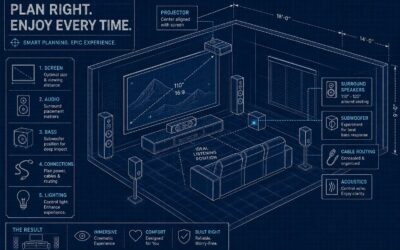
Standard guidance puts the screen center at roughly 40–42 inches from the floor for a typical seated living room setup, but the real target is your actual eye level when you’re sitting in your actual couch. A professional accounts for couch depth, room layout, and whether a tilt mount is needed to compensate for glare or an above-average mounting position. Full-motion mounts need clearance behind and beside the TV for the arm’s full extension range, and that planning has to happen before drilling, not after the bracket is already on the wall.
How much does hiring a TV wall mount installer cost in 2026?
Price by mount type
National averages land around $150–$250 for a standard professional install, according to HomeAdvisor and Angi. The Chicago market, which includes the western suburbs we serve, typically runs $110–$175 according to Airtasker’s regional data.
Ask upfront whether the quote covers only labor or includes the mount, that one question can meaningfully change what you’re comparing across bids.
Add-ons that change your total
A few common upgrades add real cost, and they’re worth budgeting for before the appointment rather than deciding on the fly. Typical ranges reported by HomeAdvisor, Angi, Kickbackservices, and Airtasker include:
A simple fixed-mount job on a drywall wall with wood studs takes 30–60 minutes. Add a soundbar and in-wall cable concealment and you’re looking at roughly 1.5–2.5 hours. Any quote promising a large, complex install in 20 minutes deserves a follow-up question.
What credentials and warranties should you actually check before booking?
The insurance question most homeowners skip
Workers’ compensation is equally important when the installer brings employees into your home; without it, you can be held liable if someone is injured on your property. Request a certificate of insurance sent directly from the insurer, not a PDF the contractor forwards. Confirm the insured name matches the business, the policy is active, and the expiration date hasn’t passed. If in-wall electrical work is involved, ask who pulls the permit and get the permit number in writing before any wire disappears into your wall.
What a real workmanship warranty covers
Most reputable installers offer a one-year limited workmanship warranty covering a loose or unstable mount, leveling issues, and hardware failure caused by the installation itself. What’s typically not covered: customer-supplied brackets that fail, pre-existing wall defects, damage from moving the TV after installation, or work later altered by another contractor. Get the warranty in writing before the appointment. A company that stumbles on that question before you’ve signed anything is telling you exactly what post-install support will look like.
Questions to ask before you hire, and how to prep for installation day
The questions worth asking every TV mounting company
A legitimate pro answers these without hesitation. A vague or deflecting response is useful information on its own.
- Do you carry general liability and workers’ comp? Can you send the certificate of insurance directly from your insurer?
- Does your quote include the mount bracket, or just labor?
- What wall types have you worked with, and how do you handle masonry or plaster?
- What does your workmanship warranty cover, and for how long?
- Who will actually show up: your employee or a subcontractor?
- Do you handle in-wall cable concealment, or will cables be surface-managed?
Red flags to walk away from
No verifiable insurance or license information provided upfront is a hard stop. So is a quote so low it can’t possibly include a second person for a 75-inch TV, or promises to “drill a few holes and see what’s there.” A professional knows what they’re drilling into before the bit touches the wall. No written scope of work and no warranty language in writing round out the list of reasons to call someone else.
How to prepare your room before the installer arrives
Clear the wall area and move furniture back enough to give the crew room to work, several feet is a practical target. Know your TV’s weight without the stand and its VESA pattern: both are on the spec sheet or the manufacturer’s website. Decide on cable management before the appointment, since in-wall concealment often needs to be scoped before drilling starts. Check where your power outlet sits relative to your planned mount location. If it’s in the wrong spot, flag it before the appointment so any electrical planning can happen before, not during, the install.
Frequently asked questions about TV wall mount installation
How do I find a reliable TV wall mount installer near me?
Start with installers who provide a verifiable certificate of insurance, a written quote, and a workmanship warranty. Check reviews on Google and look for businesses that specialize in AV or smart home installation rather than general handyman services, specialty experience matters when your wall type isn’t standard drywall.
Do TV mounting companies typically include the bracket in their quote?
Not always. Some TV mounting companies price labor only and expect you to supply the bracket. Others include it. Ask before booking so you’re comparing quotes on equal terms.
Is same-day TV mounting available?
Some installers offer same-day TV mounting for straightforward jobs in their service area. Availability depends on schedule and wall complexity. Jobs involving masonry, above-fireplace placement, or in-wall wiring usually require a scoping call first.
What’s included in a full TV and soundbar installation?
A complete TV and soundbar installation typically covers mounting the TV, mounting or positioning the soundbar, connecting all devices, managing or concealing cables, and confirming picture and audio are calibrated before the crew leaves.
How long does a professional TV wall mount installation take?
A standard fixed or tilting mount on a drywall wall with wood studs takes 30–60 minutes. Add a soundbar and in-wall cable concealment and plan on 1.5–2.5 hours. Complex installs involving masonry, full-motion mounts, or new outlet work take longer.
Book confident, not hopeful
A qualified installer does more than drill a hole and hang a screen. They assess the wall structure, anchor to what’s actually there, conceal the cables, and set the viewing angle so the result looks the way you pictured it when you bought the TV. The cost is reasonable and the appointment is short. The alternative, a TV that lists to one side or detaches from the wall six months later, is not worth the savings on a cheap or unvetted install.
Use the cost benchmarks, credential checklist, and questions above to vet your options before anyone shows up with a drill. For homeowners in Naperville and the greater Chicagoland area, My Guys Know How handles the complete job: mount selection, proper anchoring for your specific wall type, in-wall cabling, and a clean finished result with no loose wires and no follow-up calls. Reach out to our team to get a straight answer on scope and cost before your appointment is scheduled.