You’ve seen the Pinterest board. The lounge chairs, the string lights, the 75-inch screen glowing over the patio while someone grills in the background. It’s a great vision right up until your “outdoor TV” gets fried by its second summer. Your speakers start crackling through the first heavy rain like a dying transistor radio. Outdoor audio and TV installs are genuinely one of the best upgrades you can make to a home, but they’re also one of the most misunderstood. At My Guys Know How, we’ve spent years designing and installing outdoor AV systems across Indiana, Michigan, and Illinois, and we’ve seen the full range. Flawless setups that homeowners still rave about a decade later. Disaster projects that some other crew left behind. This guide covers what actually goes into a proper outdoor audio and TV install: weatherproof gear, placement strategy, wiring realities, permit requirements, realistic costs, and how to decide when to call a pro.
What “weatherproof” actually means for outdoor TVs and speakers
Most homeowners assume that anything labeled “outdoor” will survive whatever their climate throws at it. That assumption has cost a lot of people a lot of money. Weatherproof ratings vary significantly across products, and buying the wrong spec for your specific outdoor exposure is one of the most common mistakes in any outdoor audio and TV install.
IP ratings: what the numbers on the box actually mean
The Ingress Protection scale tells you exactly how much punishment a device can handle. IP55 means the unit is protected against water jets from any direction. IP65 adds full dust-tight protection with the same water resistance. IP67 means the unit can survive brief submersion. For an open, exposed patio with direct rain and full sun, IP65 is your practical minimum. A covered patio or screened lanai can often work with IP55, but if there’s any doubt about exposure level, go higher. Manufacturers aren’t being conservative when they list these specs.
Brightness requirements: direct sun vs. shaded patio setups
An outdoor TV screen needs dramatically more brightness than your living room TV to stay visible in daylight. For full sun exposure, the practical floor is around 1,500 nits. A covered patio with indirect light can work with lower nit counts. This is why you simply can’t move an indoor TV outside, even temporarily: a standard indoor panel at 400, 600 nits becomes essentially invisible in direct sunlight. Screen visibility is not a feature you can compensate for later.
Top outdoor TV picks in 2026 and what to look for in weatherproof speakers
The leading outdoor TV options in 2026 span a range of use cases and budgets. Full-sun installs are best served by the Samsung The Terrace Full Sun and the Séura Full Sun, both built for top-tier brightness and direct-sun picture quality. For covered installs, the SunBriteTV Veranda 3 has a strong track record for long-term durability. The SYLVOX Deck Pro balances weatherproofing and value well, while the Peerless-AV Neptune offers rugged, commercial-grade protection for more demanding environments. If you’re shopping for an outdoor TV enclosure to protect an existing panel, factor in that the enclosure’s IP rating needs to match your exposure level, not just the screen’s native specs.
On the speaker side, the Polk Audio Atrium 6 leads for most permanent patio installs, the Klipsch AW-650 steps up for premium sound, and Sonos Outdoor by Sonance is the strongest wireless choice if you want app-based multi-room control. Wireless options trade simplicity for consistency: they work well for smaller or supplemental zones, but wired systems hold the edge for larger, permanent setups where reliability matters more than easy setup.
The smart way to position your outdoor audio and TV installs
Even the right equipment creates a frustrating experience if it’s mounted in the wrong spot. Placement decisions made at the planning stage save time, money, and eye strain. Decisions made after drilling cost considerably more to fix.
TV mounting height, sun angle, and glare
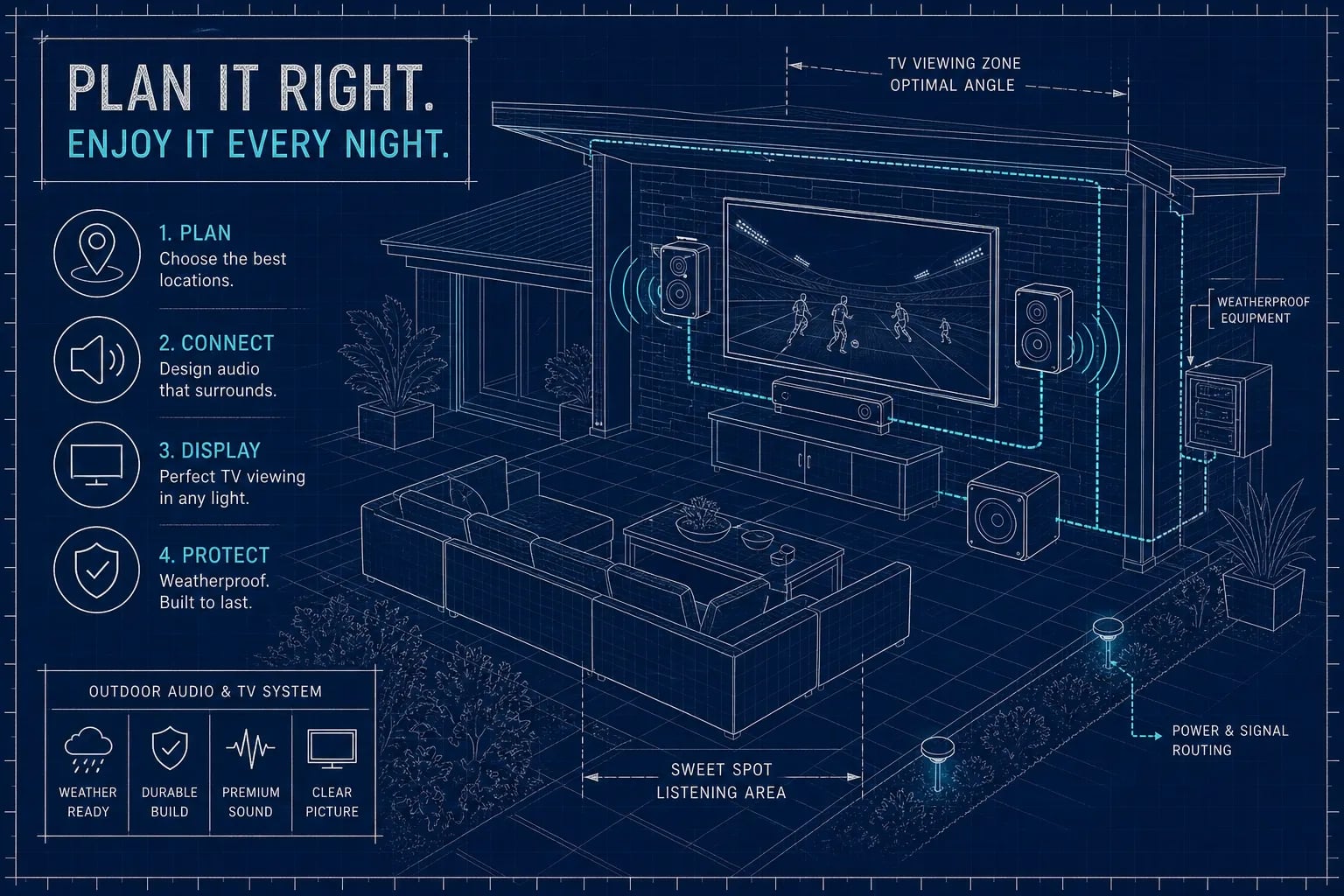
Mounting a TV too high is a common indoor mistake, and it gets worse outdoors. For seated patio viewing, the center of the screen should sit at roughly 42, 48 inches from the floor, adjusted slightly for your specific furniture height. Beyond that, you need to account for sun angle. A south-facing wall that looks perfectly fine at 9 a.m. can be completely washed out by midday, even with a high-nit outdoor TV. A full-motion mount that allows you to adjust the panel angle throughout the day, or a screen recessed under a soffit, solves this problem before it starts.
How to distribute speakers for even coverage across your space
The principle here is simple: multiple speakers at moderate volume consistently outperforms one or two loud speakers. The goal is overlapping coverage across the listening area, not a single sound source that people near the speaker hate and people across the yard can barely hear. Place speakers under eaves, above outdoor kitchen areas, along pool deck perimeters, and at opposite ends of patio seating zones. Pool and kitchen areas particularly benefit from localized speakers rather than relying on carry from a central source.
Wired vs. wireless outdoor audio: which actually holds up long-term
For a permanent backyard entertainment setup, wired is almost always the right answer. Wired outdoor speaker systems deliver better sound quality, higher volume capacity, and none of the Wi-Fi dependency or latency issues that wireless systems introduce. Wireless systems are genuinely useful for temporary zones or spots where running cable simply isn’t practical. But if you’re building a system you expect to use for the next ten years, wired infrastructure is the choice that doesn’t require troubleshooting every time your router acts up.
Power, wiring, and the stuff that quietly ruins outdoor installs
Improperly installed power is where DIY outdoor AV projects most reliably unravel. Equipment connected to the wrong circuits or run with indoor-rated cables fails quietly and expensively, often months after installation when the warranty conversation gets awkward. Weatherproof gear mounted in the right spot isn’t enough if the electrical foundation isn’t solid.
GFCI outlets, dedicated circuits, and surge protection
Every outdoor outlet must be GFCI-protected and covered with an in-use weatherproof cover. For larger setups combining a TV, audio components, and other electronics, a dedicated circuit prevents tripping issues and protects equipment from voltage fluctuations. Outdoor equipment is also more exposed to weather-related power surge risk than indoor setups, particularly during storm season. A whole-home surge protector, or at minimum a surge protector at the equipment level, is strongly recommended for any permanently installed patio speaker or outdoor TV installation.
Conduit, outdoor-rated cable, and why drip loops prevent damage
Every cable run outside, whether HDMI, speaker wire, or power, must travel through weatherproof conduit or be specifically rated for outdoor exposure. PVC Schedule 40 or 80 is the most common choice for residential outdoor runs; EMT works above grade in many jurisdictions, though local code requirements vary and it’s worth confirming with your authority having jurisdiction (AHJ) before you buy anything. Leaving cables exposed or using indoor-rated wire inside outdoor wall cavities creates moisture intrusion and code violations. Drip loops, which are intentional downward curves in the cable before it enters a port or enclosure, prevent water from wicking into connections. Every wall or soffit penetration gets sealed with exterior-grade silicone.
Where to keep AV equipment out of the weather
Amplifiers, AV receivers, streaming devices, and source components should never be mounted in open-air conditions, even if the TV itself is rated for full outdoor exposure. A weatherproof equipment enclosure, an interior closet with pass-through cable runs, or a dedicated outdoor AV cabinet protects the components that actually do the work. The TV is the part people see; the components behind it are the part that determines how long the whole system lasts.
How much outdoor audio and TV installs realistically cost
Getting a realistic budget before you start prevents the common experience of designing a setup that can’t be installed correctly for what you’ve allocated. Costs vary significantly based on patio size, equipment tier, and how much electrical or structural work the project requires.
A basic covered-patio setup with a single weatherproof TV, a straightforward speaker system, and standard installation labor typically runs between $2,500 and $6,000. This covers fundamental outdoor TV installation with minimal electrical work and a simple stereo or satellite speaker configuration. A more complete setup with multiple speaker zones, a subwoofer, better equipment, and integration into a home automation system falls in the $8,000 to $15,000 range for mid-size patios. Large multi-zone outdoor setups with premium equipment, structural integration, and full automation run $15,000 to $60,000+ depending on complexity.
On the equipment side, premium outdoor TVs start around $1,500 and climb well past $5,000 for full-sun models. As a general rule of thumb, labor often represents roughly 30, 40% of the total budget on straightforward installs, but that share rises sharply on projects that require new circuits, trenching, or structural mounting, complexity is the primary cost driver. When you’re evaluating quotes, ask specifically how that split breaks down.
Permits and code: what most homeowners skip
Outdoor AV projects touch electrical work far more often than homeowners expect, and that triggers permit requirements in most U.S. jurisdictions. Skipping permits feels like a time-saver until you sell the house or something goes wrong on an unpermitted install.
Any project that adds a new circuit, installs a new hardwired outdoor outlet, or modifies the electrical panel requires a permit pulled by a licensed electrician. In Indiana and Illinois, low-voltage signal wiring operating at 50 volts or less with no generating equipment over 50 watts is often exempt from permit requirements on its own. But the power feeding those systems is not exempt, and adding GFCI outlets, running new circuits for a dedicated AV system, or any trench work for buried cable almost always triggers a permit requirement. When in doubt, describe your project to the local building department before you buy anything.
Visible exterior equipment including large outdoor screens, speaker enclosures, and mounting hardware may also require HOA approval or need to meet local aesthetic standards. Homes in planned communities should confirm those requirements before equipment is purchased. Some municipalities also regulate noise levels and speaker placement for outdoor audio systems, particularly near property lines.
DIY vs. hiring a pro: making the call before you start
Not every outdoor AV project requires a professional installer. But knowing honestly where DIY stops being practical saves homeowners from corrections that cost more than the original installation.
The honest case for DIY (and where it falls apart)
A plug-in outdoor TV on an existing patio with a weatherproof mount and a Bluetooth speaker is a reasonable DIY project. Once the scope expands to include new electrical circuits, in-wall or in-ceiling speaker runs, multi-zone audio, buried cable runs, or integration with a home automation system, the complexity outpaces what most homeowners can execute correctly and safely. The most common DIY failure points are improper cable protection, missing GFCI protection, and TV placement that creates a glare or angle problem that’s genuinely expensive to correct once the mounting hardware is installed.
What to look for when vetting outdoor surround sound installers
A qualified installer can walk through weatherproof ratings, power requirements, and placement in a single site visit. Look for outdoor surround sound installers who ask about sun exposure, existing electrical capacity, and how the system integrates with the rest of the home before they quote. References and verifiable reviews matter more than price in a category where botched installs are common. At My Guys Know How, outdoor audio and TV installs get handled from design through installation with clean cable management and proper weatherproofing from day one, so homeowners aren’t calling someone two summers later to fix what a cut-rate crew left behind.
Red flags in quotes to watch for
Quotes that skip site evaluation, lump outdoor audio and TV into a single vague line item, or omit electrical work that the project clearly requires are worth scrutinizing closely. Ask specifically how cables will be routed and protected, what IP rating the recommended TV carries, and who handles permitting for any electrical work. Unclear answers to those three questions are a reliable signal to keep looking.
Plan your outdoor audio and TV installs right the first time
Outdoor audio and TV installs done right extend your living space and genuinely change how you use your home across every season worth being outside. Done wrong, they create years of troubleshooting headaches and sometimes real safety hazards. The difference almost always comes down to planning: choosing equipment rated for your specific exposure, placing speakers for actual coverage rather than assumed coverage, routing cables through weatherproof pathways, and understanding the electrical requirements before a single drill touches the wall.
For homeowners who want the backyard entertainment setup without the technical guesswork, My Guys Know How handles outdoor audio and TV installs end-to-end across Indiana, Michigan, and Illinois. Contact our team directly. If you want someone who knows what questions to ask before the first hole gets drilled, that’s the call worth making.